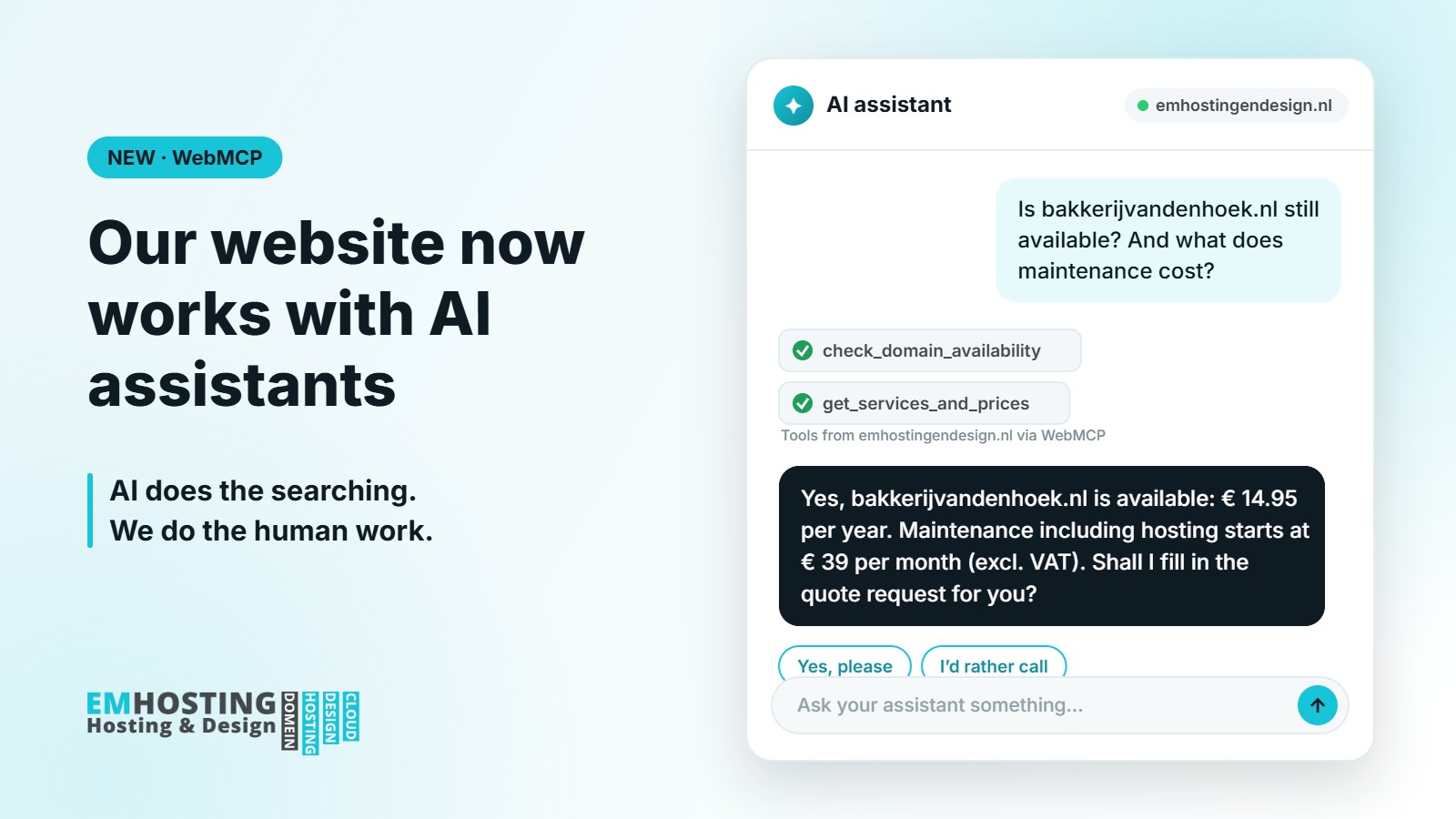
More and more people let an AI assistant do the searching: “Find a web agency that also does maintenance and request a quote.” Until now, such an assistant had to read a website the way a tourist reads a foreign menu: look, guess and hope it presses the right button. On emhostingendesign.nl that is no longer needed. Our website now tells AI assistants exactly what they can do here, through the new open standard WebMCP. Please note: this is not a chatbot on our website. It is about the AI assistant you use yourself, such as ChatGPT. As far as we know, we are one of the first web agencies in the Netherlands with WebMCP on our own website. In this article you will read what it is, what you can do with it and what it means for your business. And why, with us, people remain the most important part.
AI does the searching, we do the human work
Why are we building this? Not to replace people, but to help you better. An AI assistant looks up our prices in a few seconds or checks whether a domain name is available. That saves you searching and saves us time. We put that time into what an AI cannot do: really listening to what your business needs, thinking along with you and building and maintaining your website as if it were our own.
We read every request ourselves. You get one fixed point of contact who knows you and your business. And if you would rather just call, send a WhatsApp or have a video call? That is always possible. Of course we work with AI, but in the end it is us, as people, who help you.
From searching to getting things done
AI is now simply part of your search engine. In the Netherlands, Google Search has had an AI Mode since October 2025, where you ask a full question and can follow up. The next step has already been taken: assistants that not only answer, but also arrange things for you. On 30 April 2026, Mastercard and Rabobank completed the first Dutch payment through an AI assistant: at a customer’s request it booked a coffee tasting. And in early November, Zalando presented its first AI shopping assistant.
That changes how customers reach you. Your next customer may not type your name into Google. They ask their assistant to compare three agencies and request a quote from the best one.
The problem: today an AI has to guess
Websites are made for people. An AI assistant visiting your site takes screenshots, reads the code and tries to work out which button does what. That is slow and it regularly goes wrong: a field in the wrong place, a forgotten option, a price from an old page. The result: the assistant gives up, or tells your customer something that is not correct.
What is WebMCP?
WebMCP is an open web standard that Google and Microsoft are developing together within the W3C, the organisation behind the standards of the web. With WebMCP a website gives AI assistants a list of tools: what is possible here, which details are needed and what you get back. Instead of guessing, the assistant asks the website a question and gets an exact answer.
This is not a distant future. Since 25 August 2026 the ChatGPT desktop app has used WebMCP in its built-in browser; OpenAI calls them site tools. Chrome and Edge are currently testing WebMCP, and Google has announced that Gemini in Chrome will follow. Thousands of websites worldwide already support it.
What an AI assistant can now do on our website
We built nine tools, in all five languages of our site: Dutch, English, Italian, German and French. A few examples:
| You ask your assistant | What happens |
|---|---|
| “What does maintenance cost for my WordPress site?” | The assistant retrieves our three maintenance packages, with the price and what is included. Exactly as on our site, so no outdated or invented amounts. |
| “Is bakkerijvandenhoek.nl still available?” | A live domain check: free or taken, the price per year and a link to register the name right away. |
| “Show me websites you have made for restaurants.” | Projects from our portfolio, by sector, with a link to each case. |
| “How do I back up my WordPress site?” | The assistant finds the right article in our blog. |
| “How can I reach you?” | Phone, WhatsApp, email and when we are available. |
| “Request a quote for an online shop for my bakery.” | The quote form opens, already filled in. You check it and send it yourself. |
An assistant can also prepare a request for maintenance with Verploy or for a website analysis in the same way.
You stay in control
An AI assistant never sends anything itself on our website. With a request, the right form opens, already filled in with the details you gave your assistant. Above the form it clearly says that the AI filled it in. You check everything and press send yourself. That way you know exactly what goes to us, and we receive no automated spam.
Ordinary visitors notice nothing. The tools are only there for AI assistants in a browser that supports WebMCP, and we collect no extra data.
Built by the team behind Verploy. The team that made Verploy, our own maintenance platform that monitors all our clients’ websites day and night, also built our WebMCP tools. The prices come straight from our order module. If we change a price, an assistant immediately gets the new amount.
Try it yourself
Do you use the ChatGPT app on your computer? Then open emhostingendesign.nl in the app’s built-in browser and ask, for example:
- “Which maintenance packages does EM Hosting & Design offer and what do they include?”
- “Is mycompanyname.com still available?” (with your own name, of course)
- “Show three websites EM Hosting & Design has made for hospitality businesses.”
Next to the address bar you will then see Site tools. They work in the latest version of the app, on the plans and AI models for which OpenAI has enabled them. As soon as Chrome, Edge and Gemini support WebMCP by default, it will work there too.
Why this matters for your business
Ten years ago the question was whether your website worked well on a phone. Now the question is whether an AI assistant can do something with it. A website that an assistant can use well is chosen more easily: the answer is right and the request succeeds the first time. It is the next step after findability in Google and AI: first being found, then being usable as well.
What that means for your website depends on what you do:
- Online shop: an assistant searches products, compares sizes and prices and fills the cart. The customer pays themselves.
- Holiday rental or B&B: an assistant checks availability and prepares a booking request, without commission from a booking site.
- Service provider: an assistant requests a quote or schedules an appointment, with all the details you need.
WebMCP is an open standard. So you are not tied to one AI company: the same tools work in every assistant that supports the standard.
What you can already do now
- Put your services and prices clearly on your website. What is not there, an assistant cannot pass on either.
- Keep your forms simple: clear labels and as few required fields as possible. How to make a page that brings in enquiries is explained in How to write a services page that brings in enquiries.
- Give search engines and AI structured data about your business, opening hours and products. Read more in Findable in Google and AI.
- Keep your website fast, secure and up to date. An assistant gives up just as quickly as a person.
- Give your most important actions their own WebMCP tool: a quote, an appointment, a booking or a product search.
And measure what it delivers. How to see where your enquiries come from is explained in Measuring is knowing: how to see what your website really brings in.
Frequently asked questions about WebMCP
What is WebMCP?
WebMCP is an open web standard that lets a website tell AI assistants what they can do there: what information is available, which actions are possible and which details are needed. Google and Microsoft are developing the standard together within the W3C.
Is WebMCP a chatbot on my website?
No. Your visitors see nothing of it. WebMCP helps the AI assistant someone already uses, such as the ChatGPT app, to understand and use your website properly.
Which AI assistants support WebMCP?
The ChatGPT desktop app has used WebMCP in its built-in browser since August 2026. Chrome and Edge are testing the standard, and Google has announced that Gemini in Chrome will follow.
Does WebMCP work with WordPress and WooCommerce?
Yes. Our own website runs on WordPress. For a WooCommerce shop we can build tools such as searching products and filling the cart. Which tools make sense depends on what your customers want to do on your website.
Will WebMCP make me rank higher in Google?
Not directly. WebMCP makes sure an AI assistant can use your website; as far as is known it is not a factor for your position in Google. To be found, good content, a fast and secure website and structured data remain the basis. That is why we tackle both together.
Is WebMCP safe?
An AI assistant can only use the tools the website itself offers. On our website an assistant can request information and fill in forms, but never send anything itself: you do that.
Would you like this for your website too?
We build WebMCP tools for your website or online shop, tailored to what your customers want to do: request a quote, make an appointment, check availability or search products. Tell us below what your website should be able to do. We will show you what is possible, without obligation. You simply talk to us: people who help you, with AI as a handy tool.
Book an introductory call Ask your question on WhatsApp
Prefer to call? +31 (0)6 402 103 11, Mon–Fri 9:00–17:30 (CET).